Reconstructing Megalodon
Research, 3D modeling, and a new approach to exhibit development
Growing up, my class took field trips to the North Carolina Museum of Natural Sciences, and like everyone around me, I was certain the giant megalodon jaw on display was a real fossil. It wasn’t until I studied paleontology in college that I learned the truth: no one has ever found a megalodon jaw. That gap between what visitors think they’re seeing and what we actually know became the question behind my undergraduate research at Appalachian State University.
The Question
Otodus megalodon was the largest shark we know of, an estimated 15 to 20 meters long, with a jaw roughly 2.5 by 3 meters holding as many as 273 teeth. But sharks have cartilage skeletons rather than bone, so they rarely fossilize. No complete megalodon jaw has ever been preserved, and the most complete sets of teeth sit in private collections. That means every towering jaw you see in a museum is a reconstruction, and most lean heavily on the modern great white shark as a model. The problem isn’t that museums reconstruct; with no fossil to work from, they have to. The problem is that these displays usually present the result as settled fact, so visitors walk away, as I once did, with a false sense of how much we really know.
What I Did
Working as a Paleontology Undergraduate Research Assistant, I set out to map what’s actually known about megalodon and to test better ways of showing it. I interviewed museum professionals and megalodon experts about the fossils and data behind their reconstructions. I 3D-scanned a real megalodon tooth and used it to model erupting upper-left and upper-right tooth whorls. I made silicone molds and resin casts of juvenile teeth, hand-painted them to match the originals, and built physical tooth whorls a visitor could pick up and examine. I also 3D-printed teeth and compared the two methods directly: casting captured finer detail and made sturdier replicas, while printing was lighter and easy to scale. To tackle size, I estimated body length from tooth crown height using a published equation, then checked those estimates against factors like climate and geologic time. From all of this I built hands-on outreach displays, including cast teeth paired with string laid out to the shark’s estimated length, and pick-up tooth whorls that correct a surprisingly common misconception about which way the teeth actually face.
What I Proposed
The bigger idea grew out of a pattern I kept noticing: museums tend to present science as fixed and finished. Megalodon is a perfect case for flipping that. I designed two versions of an exhibit in Adobe Illustrator, one modeled on a typical current display and one of my own, “The Science Through Time of Carcharodon megalodon,” built around the past, present, and future of what we know: the earliest reconstructions, what’s firmly established today, the open questions that remain, and how the great white came to stand in for the real thing. I ran a small front-end evaluation, giving eight visitors a single design each with matched pre- and post-questions. The visitors who saw my version came away with more accurate understanding, and every one of them said they’d rather explore it. The sample was small, a limitation I’d want to fix with a larger study, but the takeaway held: an exhibit that’s honest about what’s unknown can teach more than one that projects false certainty. That conviction, that there’s strength in showing people how science actually works, still shapes how I approach exhibition development today.
Presentations & Paper
“Analyzing Reconstructions of the Giant Fossil Shark Otodus megalodon and Proposing a New Process Behind ‘megalodon’ Exhibit Development”
— Society of Vertebrate Paleontology (SVP) Annual Conference, 2024
— Southeastern Section, Geological Society of America (GSA) Conference, 2024
Full paper available on request.
Otodus megalodon Casting and 3D Printing


Otodus megalodon tooth whorls made out of casts. These casts were made from molds of megalodon teeth that I created.

Otodus megalodon tooth whorl made from 3D printed teeth.


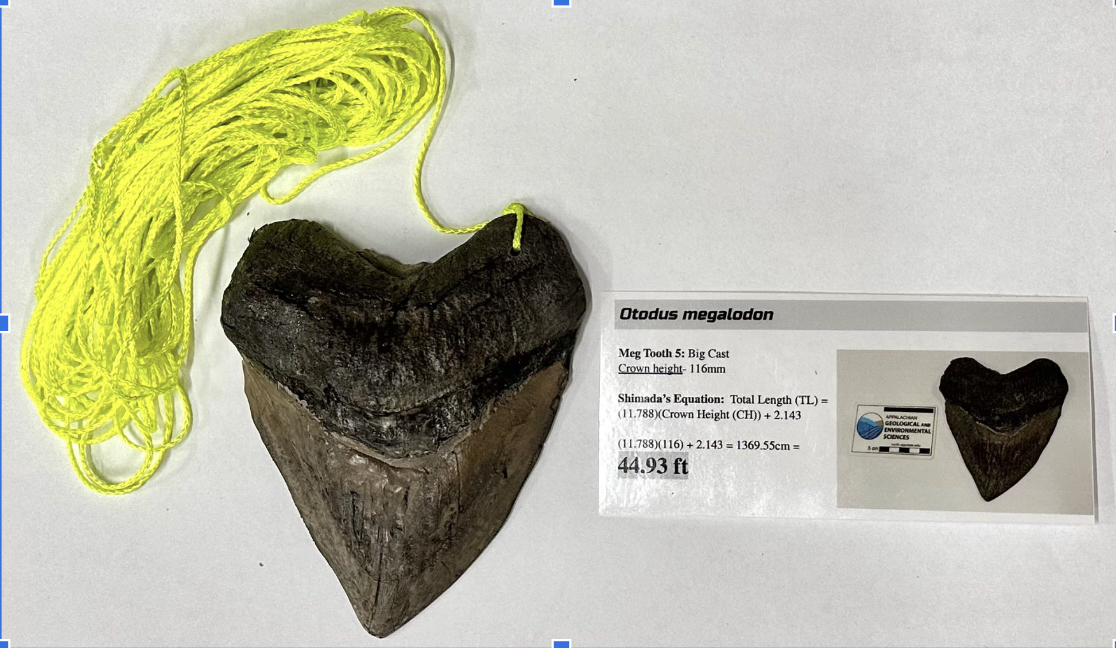
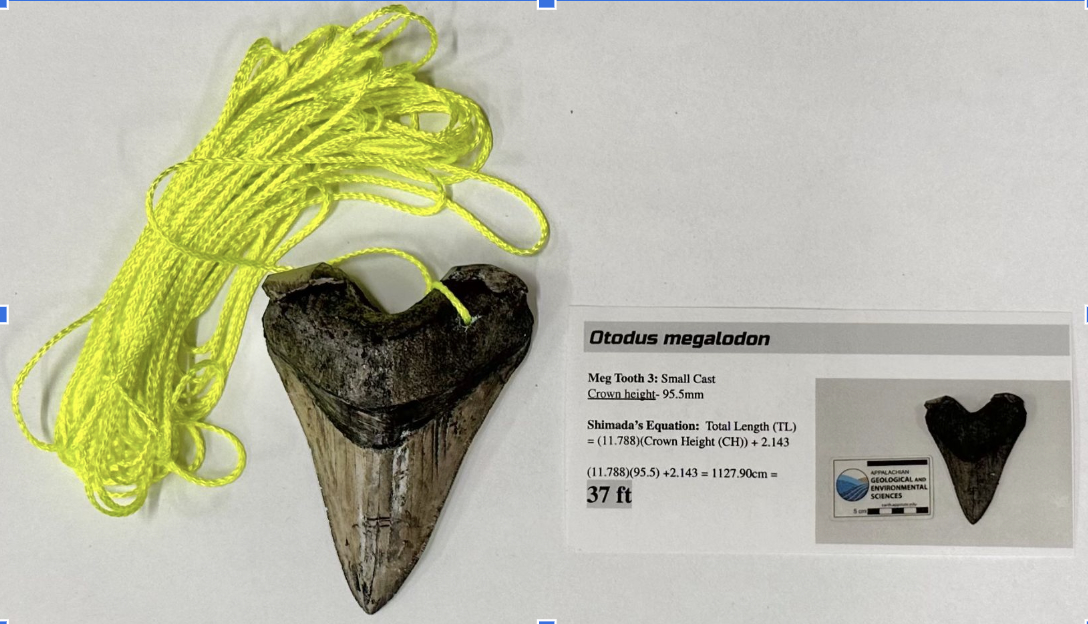
Estimation of body size based on tooth measurements with notecards created on Adobe Illustrator and casts of megalodon teeth with the length of the shark in string attached.